Bearings are frequently called the “joints of industry.” Obtaining the option right straight impacts your devices’s integrity, life span, and upkeep prices. Several bearing failings don’t come from low quality– they come from incorrect options. Things like load calculation errors, overlooking rate restrictions, or picking the incorrect lubrication technique. These tiny blunders can create tools to damage down early in its life span. This guide strolls you with the whole option process, giving designers and procurement professionals a clear course from evaluating working problems to confirming the right bearing version.
Component One: What You Need to Know Before Starting
Prior to you open any bearing brochure, ask on your own one question: What exactly does this maker require the birthing to do? The answer lies in five crucial areas:
1. Lots Qualities
Load is the top factor in birthing selection. You require to identify three things:
Direction: Is it radial tons (vertical to the shaft), axial lots (parallel to the shaft), or a mix of both?
Size: Is it light, modest, or heavy? Any kind of impact lots?
Nature: Is the lots constant or transforming? How typically do impact loads happen and exactly how strong are they?
Take a belt conveyor for example. The bearings at the drive end take on radial loads from belt stress, the weight of the belt and rollers, plus the shaft assembly. When determining, you have to take into consideration different operating problems– start-up, regular operating, stopping– and use the worst-case circumstance for your design.
2. Speed Conditions
(bearings for steel mill)
Speed is an additional vital element influencing bearing life. According to fatigue life concept, birthing life has an inverted connection with speed. For variable rate problems, you require to calculate the comparable rate. Take a rotating kiln support roller– its rate could range from 0.5 to 2.5 r/min. You would certainly require to weight the running time at each rate to get a comparable value.
One thing to watch out for: knowing only the maximum rate can mess up your lubrication strategy. The lube you choose based on top speed might not create a proper oil film at reduced speeds. Also, if your maker has long idle durations, you must discuss that– otherwise neighboring devices vibrations might trigger incorrect brinelling damage.
3. Required Service Life
Birthing life span is generally shared as L10h (the variety of hours that 90% of a bearing team will certainly get to before fatigue spalling appears). A common blunder is going with an excessively long life– when L10h goes beyond 100,000 hours, the bearing dimension obtains too big. It ends up being tougher to lube, torque boosts, and it comes to be extra sensitive to minimum tons. In the end, it could stop working for factors besides tiredness.
4. Space Constraints
You must understand your offered room restrictions from the beginning– shaft diameter variety, housing bore size, axial length limits. As soon as you recognize the matching shaft size and available room, you can promptly limit your choices.
5. Running Precision Demands
The majority of applications do just great with common precision bearings. But for high-speed or high-precision tools like maker tool pins, you’ll need P5, P4, or even greater grades. Simply remember that choosing greater accuracy without an actual demand will increase expenses considerably. Suit the grade to your actual needs.
Sequel: Matching Bearing Kinds to Working Conditions
As soon as you have those parameters clear, the following step is to match the ideal bearing type based on load direction, size, rate, and misalignment resistance.
1. Load Instructions: Radial, Axial, or Incorporated?
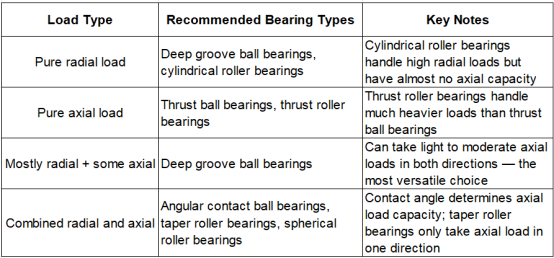
This is the most standard filter. It can aim you to a couple of candidates right away:
When the axial-to-radial load proportion (Fa/Fr) adjustments, your selection reasoning modifications as well. At low ratios, select deep groove sphere bearings. At modest ratios, make use of small-contact-angle angular contact bearings or taper roller bearings. At high ratios, you’ll need large-contact-angle bearings, or take into consideration combining a thrust bearing with a radial bearing.
( Radial)
2. Load Dimension: Round Bearings or Roller Bearings?
This is a traditional selection:
Light or moderate lots: Opt for ball bearings (deep groove or angular get in touch with). The factor contact in between balls and raceways offers reduced friction, making them appropriate for tool to high speeds.
Heavy or effect tons: You should utilize roller bearings (round, round, or taper). Line call in between rollers and raceways supplies much greater tons ability and better effect resistance.
3. Speed: Ball Bearings for Broadband, Roller Bearings for Low
Typically talking, round bearings have greater rate limitations than roller bearings. For high-speed applications (over 1000 r/min), placed sphere bearings on top of your checklist. When you need the greatest feasible rate with pure radial lots, open deep groove round bearings are your best choice. For incorporated loads at high speed, angular call ball bearings are the means to go.
Round roller bearings, taper roller bearings, and needle bearings have relatively reduced speed restrictions. They’re mainly matched for low-to-medium rate, heavy-load problems.
4. Misalignment Tolerance: Do You Need Self-Aligning?
This set commonly gets neglected however it’s exceptionally vital. You should take into consideration self-aligning bearings when:
Birthing housing bores do not line up well
The shaft isn’t stiff sufficient and bends throughout procedure
The bearing period is long and thermal growth triggers angular misalignment
You’re utilizing separate split real estates (like cushion block bearings)
Round roller bearings and spherical ball bearings have scooped external ring raceways. This allows a particular quantity of angular misalignment between the inner and external rings without unsafe side stress. They can make up for both dynamic deflection and fixed installment mistakes.
On the various other hand, cylindrical roller bearings, taper roller bearings, and needle bearings have very limited self-aligning capacity. Even a little angular misalignment can trigger stress and anxiety concentration at the roller finishes, resulting in high edge stress that dramatically reduce birthing life. Deep groove round bearings do have some self-aligning capacity, but the permitted angle is tiny– going beyond it will reduce life also.
5. Axial Expansion Settlement: Fixed End or Floating End?
Lengthy shafts expand and agreement with temperature modifications during procedure. That suggests you need to set up your bearing setup with one fixed end and one floating end.
NU and N series round roller bearings have no flanges on the internal ring (or on one side). This allows the shaft action freely in the axial direction relative to the real estate– making them perfect as floating-end bearings. NJ and NUP series can provide axial positioning in one or both directions, so they function well as fixed-end bearings. This setup is extremely common in transmissions and electric motors.
Component 3: BMB Product at a Look
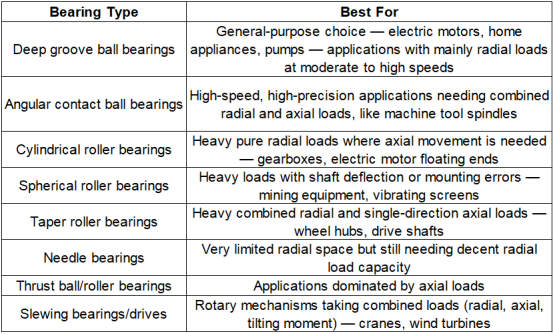
BMB provides a total range of industrial bearings, covering all the major kinds we have actually discussed. This fast referral table attaches the choice concepts above directly to details product groups:
Part Four: Diving Deeper– Precision, Clearance, Lubrication, and Seals
( Axial)
1. Precision Grades
Standard accuracy (P0) helps the substantial majority of basic equipment. For precision tools like maker device pins or aerospace parts, you’ll need P5 or greater. Tighter precision suggests tighter dimensional tolerances and better running precision– however also greater expenses.
2. Inner Clearance and Preload
Bearings need to keep proper internal clearance after installment. Too much clearance brings about resonance and sound. Insufficient, and thermal expansion can create the bearing to seize. In special cases like machine device pins, preload (applying negative clearance) is used to boost system strength and rotational precision.
3. Lubricant Option
Lubrication is a make-or-break aspect for birthing life. Grease works for most moderate-speed and temperature level applications– it’s simple to secure and can run maintenance-free for extended periods. Oil (oil bathroom, oil mist, jet lubrication) is much better for high-speed or high-temperature problems, as it dissipates warm more effectively. When choosing a lube, examine the speed element (ndm worth). Don’t simply pick based on maximum rate– the oil you choose may not develop a correct film at reduced rates.
4. Sealing Arrangements
Choose the seal kind based upon your atmosphere: call seals keep dust out well yet add some rubbing; non-contact seals work for broadband yet provide much less protection against contamination; open bearings count on external securing systems.
Part 5: Life Calculation– From Theory to Technique
( or Combined Basic Filter Table)
At the end of the day, you require to verify whether your selected bearing will really satisfy the anticipated service life. This is where fundamental rating life estimation is available in.
The basic score life L10 formula (ISO 281 standard):
For ball bearings: L10 = (C/P) FOUR × (10 SIX/ 60n) hours
For roller bearings: L10 = (C/P)^(10/3) × (10 ⁶/ 60n) hours
Where:
C: fundamental dynamic load score (kN)– located in the product directory
P: comparable dynamic lots (kN)– takes both radial and axial tons right into account
The equivalent dynamic load P is calculated as: P = X · Fr + Y · Fa
Fr is the radial tons, Fa is the axial lots
X and Y are coefficients that depend on bearing kind and the Fa/Fr proportion– inspect the directory for these worths
For more demanding problems, you can apply modification factors: Ln = a1 × a2 × a3 × L10
a1 is the reliability element (a1 = 1 for 90% reliability, regarding 0.21 for 99%)
a2 is the material element (premium bearing steel can reach 1.5 to 2)
a3 is the operating conditions aspect (great lubrication and cleanliness can provide 2 to 3)
With this estimation, designers can verify that the selected bearing meets the required service life. It likewise assists compare numerous options and make data-driven choices.
This overview has actually strolled you via the total option path– from assessing working problems, to matching the best bearing type, to verifying life expectancy. Understanding and applying this technique will aid you make accurate, reliable, and cost-efficient bearing choices throughout a wide range of commercial applications.
Supplier
Bmb Bearing is a professional industrial bearing supplier dedicated to delivering high-quality, reliable solutions for global industries.
Our comprehensive product range covers all major bearing types: deep groove ball bearings, spherical roller and ball bearings, cylindrical roller bearings, taper roller bearings, angular contact ball bearings, thrust ball and roller bearings, slewing bearings, slewing drives, and needle bearings.
Engineered for durability and precision, these bearings meet the demands of machinery, manufacturing, and heavy-duty operations. We focus on quality assurance, competitive pricing, and responsive service to support your projects with the right bearing solutions every time.
All articles and pictures are from the Internet. If there are any copyright issues, please contact us in time to delete.
Inquiry us