PTFE, notoriously known as Teflon, was not a prepared exploration. In 1938, DuPont came across this exceptional compound quite by accident, sparking a transformation in products science and commercial applications.
One morning in 1938, Roy Plunkett, a young drug store, was hectic playing with his experiments behind-the-scenes of DuPont. His task seemed basic: locate a new refrigerant.

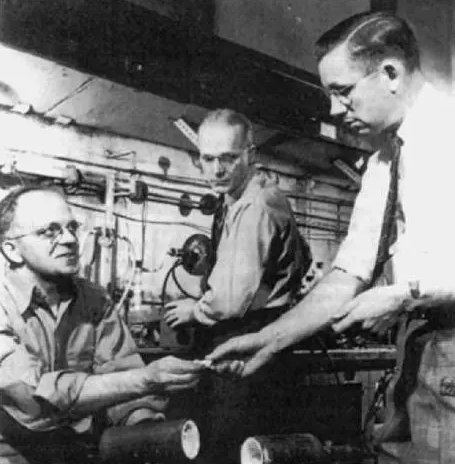
(Roy and his colleagues)
Nonetheless, simply when Roy believed it was just a regular task, points took a turn. He kept the tetrafluoroethylene gas in a cyndrical tube and stated to himself: “Okay, see you tomorrow.” The next day, when he returned to proceed his experiment, he discovered that the gas had actually strangely vanished, leaving only a pile of white powder. Well, this was certainly different from the script he intended. Imagine his expression during that time: half overwhelmed, half interested. Upon more investigation, he discovered that this odd white powder had some great superpowers: it was unfriendly to mostly all chemicals, might stay cool at extreme temperatures, and was as unsafe as oil. Instantly, Luo realized that while he had yet to locate a brand-new cooling agent, he had actually unintentionally uncovered the secret active ingredient of the kitchen superhero of the future – non-stick frying pans. After that, frying eggs was no more a difficulty, and cleaning pots came to be a breeze.
Although the discovery of PTFE was accidental, it had significant cutting edge importance for the plastics market and many other fields, such as aerospace, vehicles, electronics, and devices. PTFE is widely utilized because of its special chemical and physical residential or commercial properties – incredibly reduced rubbing coefficient, high-temperature resistance, chemical stability, and non-stickiness. From kitchen area utensils to important parts of the space capsule, PTFE made many cutting-edge applications feasible. Yet while PTFE (Teflon ®) noted an innovative advancement in products science, it was only the start of a long and tough road to commercialization and widespread application. The preliminary difficulty was not only to uncover a brand-new product yet also to identify exactly how to attain large-scale manufacturing and just how to use it in various fields.
The procedures of monomer synthesis and regulated polymerization of PTFE were not fully developed, making it difficult to generate PTFE in huge quantities or a possible way. While the material’s one-of-a-kind homes were helpful in the long run application, they likewise postured significant obstacles throughout the production procedure. Unlike various other typical plastics, PTFE is not soluble in solvents, acids, or bases and does not melt into a flowable fluid. Instead, when heated up, it comes to be a hard, clear gel that does not thaw and flows like plastics.
(Roy’s Notes: Discovery of PTFE)
To conquer these obstacles, researchers and engineers struggled to find procedures from various other areas, such as adapting strategies from metal and ceramic processing. To shape PTFE, a procedure called paste extrusion was utilized, which was obtained from ceramic handling. Although standard molding and creating techniques had some trouble refining PTFE, it was possible to produce PTFE components. By 1947, extensive research and testing had borne fruit, and a small-scale production center was established in Arlington, New Jacket. This marked the start of Teflon ®’s trip from the laboratory to the market. In 1950, DuPont opened up a new plant in Parkersburg, West Virginia, dramatically broadening the business production of Teflon ®. That same year, the innovation went across the Atlantic when Imperial Chemical Industries constructed the very first PTFE plant outside the USA in the UK.
Provider of PTFE Powder
TRUNNANO is a supplier of 3D Printing Materials with over 12 years experience in nano-building energy conservation and nanotechnology development. It accepts payment via Credit Card, T/T, West Union and Paypal. Trunnano will ship the goods to customers overseas through FedEx, DHL, by air, or by sea. If you want to know more about colored stamped concrete, please feel free to contact us and send an inquiry.
Inquiry us